Make website

Subscribe For Free Updates!

We'll not spam mate! We promise.

Friday, April 15, 2011

Sony Cyber-shot DSC-TX5 Review

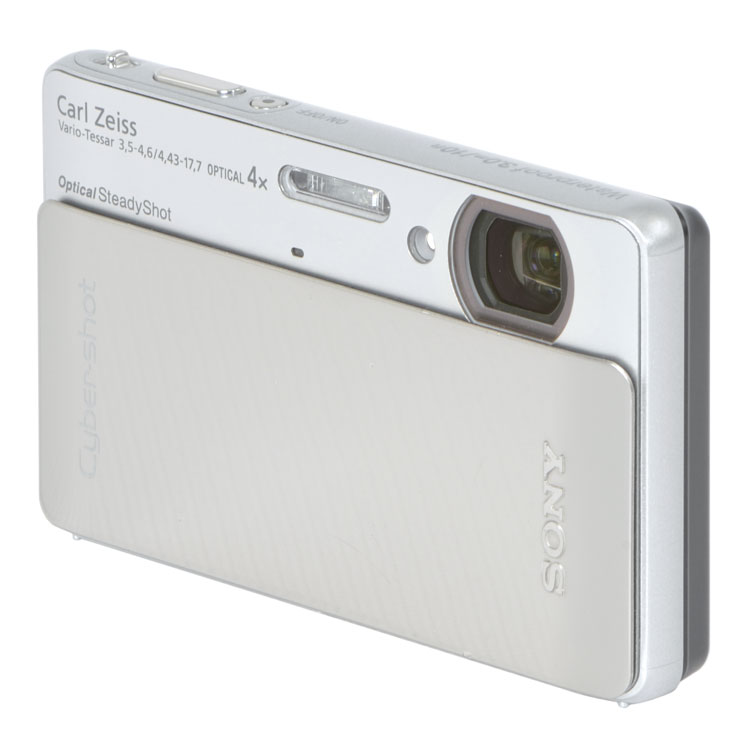
All tough cams are not made equally – or similarly for that matter. Sony offers up the world’s slimmest rugged point and shoot, along with a very capable touchscreen responsible for most of the camera’s operations. Its most notable elements will either win users over (tiny size, touchscreen dependence) or be the reason they opt for a competitor’s camera like the Olympus TG-610.

Sony Cyber-shot DSC-TX5Features and design

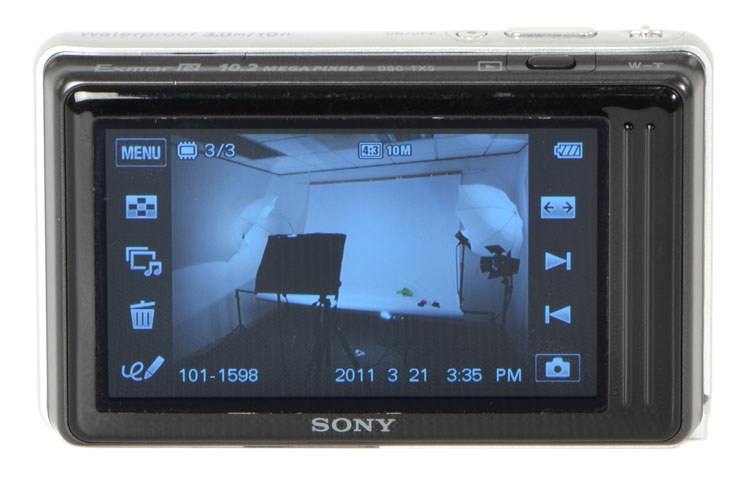
First off, we’ll start with what the TX5 has going for it. It’s an incredibly light and slim device, with a sliding panel to protect the lens. Touch pocket cams don’t always have the luxury of being quite as convenient to carry as Sony’s – it weighs a mere 5.1 ounces and its backside is all screen. The 3-inch LCD touchscreen packs approximately 230,000 pixels in resolution. It registers touch surprisingly well and doesn’t require tap after tap after tap to get where you want to go – but always expect this to get a little more difficult underwater, or while wearing gloves.
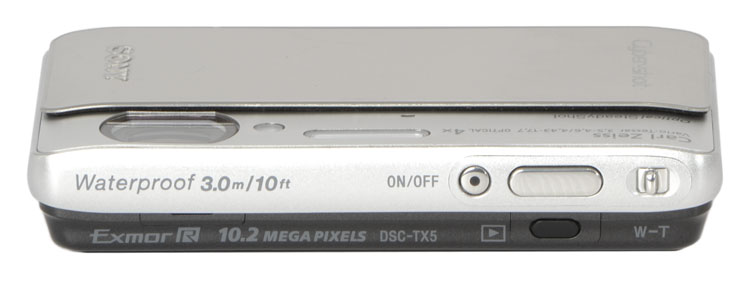
But back to what it does well. The sliding panel not only protects the camera lens but functions as a power switch, yet another convenience in a tough cam. And it’s virtually buttonless: There is a designated power button, zoom, playback, and shutter control, but that’s it. If you’re planning to exploit everything this camera can do in the great outdoors, you’ll be happy with the lack of tiny bells and whistles you need to manipulate. Of course, if you’re unfamiliar with touchscreen controls or have an affinity for messing with the smallest details of your photo setup, it might be frustrating to have it confined to the screen. That said, the learning curve with the touchscreen controls is anything but steep.
The TX5 comes equipped with a slew of scene selectors, included “snow,” “beach,” and of course “underwater.” To get more specific, users also various white balance options and of course, more experienced photographers can alter ISO sensitivity themselves. But the camera’s real selling points are its simplicity and durability.

What’s in the box

The TX5 comes with the camera, a startup and help guide CD, wristband, multi-connector cable, NP-BN1 battery, and battery charger.

Performance and use

The most impressive feature the TX5 is arguably its speed. Consumers should be able to use tough cams to their fullest abilities, and sometimes it seems like their indestructibility takes precedence over their speed. But the TX5 comes packaged with an incredibly capable sensor and processor – the Exmor R CMOS sensor and the BIONZ processor – that allow it to take 10 frames in one second at its full 10.2-megapixel resolution.
Sony Cyber-shot DSC-TX5
The camera’s wide-angle 4x zoom gives photographers some room to work with: It offers some variety and makes landscape shooting a possibility, which can’t be said for every pocket cam out there. The camera’s built-in scene selectors also work well, and can further simplify using the TX5 for novices. Better yet, the touchscreen interface is extremely intuitive when it comes to using and finding these presets. Just like any good outdoor-use camera should, it comes with a panorama option. It’s a different take on the feature, however: You simply select the mode and then follow the easier than easy instructions which include an arrow telling you to sweep the camera across your desired landscape. It then processes the image for you; push it to the limits and it can capture an image with a 258 degree field of view. Of course, the quality can’t be compared to costly DSLRs like the A55, but it shouldn’t have to be. The TX5 performs admirably in low light, thanks to its sensor, but be ready for some lag with the auto focus.
Sony Cyber-shot DSC-TX5
While the diminutive size is convenient for packing and pocket purposes, that doesn’t always mean it’s easier to use. The zoom toggle is absolutely miniature; using it with gloves or underwater could prove difficult. And sure, no one wants a weight secured to their wrist – but the TX5 feels like it could blow away. The child-sized camera might just be too small for some, and while a 3-inch display is impressive for a device so small, it’s a relatively small space to work entirely within.

Conclusion

If you’re specifically on the hunt for a dustproof, waterproof, shockproof, freezeproof point-and-shoot that you can really subject to the elements and push to the weather limits, the TX5 will do, but it can easily be bested by cameras without rugged specs. A slightly heavier device that doesn’t entirely rely on a touchscreen will also be easier to manipulate in your more extreme photography sessions.
That said, if you’re looking for a quality point and shoot that can double as your rugged cam, the TX5 is a great option. The touchscreen isn’t anything to be afraid of, even for those unfamiliar with it. And for general use, its size is definitely a plus, not to mention its iAuto and built-in scene options. However, for its price we’d expect some artsy filters or expanded editing capabilities.

Highs:

  • Responsive touchscreen
  • Impressive in low light
  • Panorama sweep is a nice bonus feature
  • Sliding on/off panel is convenient

Lows:

  • Too small
  • Touchscreen only operation might scare some off
  • Competitors have more built-in features to offer
  •  Touchscreen can be difficult to manipulate in some “tough cam” scenarios
 

Wednesday, April 13, 2011

T-Mobile unlimited everything plans made official, heavy data users to have speed capped

T-Mobile confirms the launch of two new wireless plans which offer unlimited every -- voice, data and text -- for industry-low prices, the trade off being that those with more than 2GB of data usage in a month will be speed-capped.
What first popped up as a rumor earlier this week is now an officially confirmed fact: T-Mobile has launched a pair of new pricing plans which offer unlimited domestic airtime, text messaging and data access. The plans are split between the wireless carrier’s two price tiers, Even More and Even More Plus. The former carries at $79.99 per month price tag and includes a discounted phone and a two-year contract commitment. The latter costs $59.99 per month; with this one, you don’t get a discounted phone but you also don’t have to make a contract commitment.
The new plans will only be available for a limited time, according to the T-Mobile press release. Though given the fact that AT&T recently moved to acquire the company, all time is limited at this point. There’s a big, fat catch that data users will need to consider with these two plans, however. As the press release states: “Consumers exceeding 2GB of usage in a billing month will still have access to unlimited data at reduced speeds until their new billing cycle starts.”
That should be clear enough. Use too much data in a month-long window, and T-Mobile will throttle your speeds. In fairness, most on-the-go Internet users don’t manage to reach such heights in their daily data usage. Then again, T-Mobile is “America’s Largest 4G Network.” It’s a lot easier to kill time on your web access-equipped smartphone when your average site takes that much quicker to load.
Before you go and get bent out of shape, screaming for blood over the very idea that your wireless carrier would have the nerve to cap your data speeds, remember that an unlimited data plan is an exception rather than a rule these days. These plans are very affordable. A comparable plan with AT&T, for example, which would still cap your data usage at 4GB (with overage charges being applied after that), would run you in excess of $130 per month after taxes and surcharges. So go ahead and celebrate, T-Mobile customers. The speed limiting is unfortunate, but it’s a worthwhile trade off for unlimited data access on the go.

Apple to launch revolutionary cloud-based TV service, says analyst

Apple has forever altered the music industry with its popular products. But now, says analyst Peter Misek, Apple plans to launch new products and services that will transform the television industry as well.
apple-tv
Apple could soon debut a cloud-based video service that will have “far reaching” implications for the television industry, says Jefferies & Co analyst Peter Misek. The purported launched could bring both new subscription services and new hardware that will amount to nothing less than an “assault on the living room” as we know it.
“In addition to subscription revenues, we think Apple could potentially benefit from a halo effect that increases units and average selling prices for its existing products and provides a foundation for the launch of an iTV-like device,” wrote Misek, which he says could arrive in 2012 or 2013.
The prediction, first reported by The International Business Times, was made in a research note to clients for which Misek checked in with “developers and content providers on Apple’s possible plans regarding the cloud and their assault on the living room.”
Misek says that Apple is planning to open another massive data center directly next door to the one it recently opened in North Carolina. His information is based on aerial footage, which shows that the land adjacent to the current data center has been cleared, most likely to make room for another data center. Also, says Misek, a site mock-up at Apple’s announcement ceremony for the current data center — the largest in Apple’s storage arsenal — showed two side-by-side data centers.
In addition, Misek believes that Apple is planning to open similar data centers in other parts of the US and Europe.
Apple has confirmed that the data center in North Carolina, which was completed earlier this year, will be used for iTunes and MobileMe. This further fueled rumors that Apple has plans for a cloud-based iTunes service, launched in conjunction with a revamped MobileMe “digital locker” for music and video collections, which would allow users to stream their media libraries from any iOS device.
According to Misek, however, Apple’s cloud plans go beyond music, since he believes the capacity of the data centers are more than what’s needed to support relatively small music files. In addition, Misek believes Apple is currently negotiating with television networks to distribute their content to iOS devices, which would explain the recent litigation against the Time Warner and Cablevision TV streaming apps.
“We find it notable that the content companies, citing a lack of domain license, asked Cablevision to remove channels from its iPad app,” writes Misek. “We believe these same companies are negotiating some sort of deal with Apple.”
Misek says that Apple will “convince Hollywood and other content creators” to license their products for an Apple service by using the same model they employ with app developers, which allows them to “take the vast majority of the revenue” from the content, while Apple makes its money from the devices.
Lastly, Misek says that Apple CEO Steve Jobs could be stepping down soon, and its likely that revolutionizing the television industry — just as his company revolutionized the music industry — would be an apt parting act.
“We would find it easy to believe that Steve Jobs’ final hurrah before turning the reins over would be to revolutionize video much in the same way Apple has transformed the mobile, computing, and music world. It is also notable that his authorized biography is due in 2012.”

HP EliteBook laptops get sleek, Apple-like redesign

Today, HP has announced a redesigned, more durable line of EliteBook laptop computers. The new notebooks also use the electronics maker's new DreamColor screen technology, allowing more vivid color.
Today, Hewlett Packard revealed a redesigned line of EliteBook laptops that use the “Forge” design framework it introduced on its business notebooks in February. The new designs are meant to be simpler looking, more durable, more reliable, and are built in a more environmentally friendly way. The new EliteBooks feature a gunmetal brushed finish, backlit HP logo, and “orange-colored accents.”
Replacing the EliteBook 8440w, 8540w, and 8740w, will be the EliteBook 8460w, 8560w, and 8760w, which range from 14 inches to 17.3 inches in size.
All of the new models have full HD screens and a choice between AMD FirePro or Nvidia Quadro graphics cards. The two larger laptops also feature HP’s new DreamColor display that can “allow for more than 1 billion active color combinations–64 times the capabilities of a traditional display–and uses a 30-bit notebook LCD panel” for brighter, better color. We have yet not seen the EliteBooks or DreamColor display in action.
 As the fastest growing segment of the workstation market, mobile workstations continue to provide value to our most demanding design, animation and engineering customers,” said Efrain Rovira, director, Mobile Workstations, Notebook Business Unit, HP. “The new EliteBook mobile workstations announced today combine innovative design with trusted, workstation-class technology to fuel creativity.
 The smallest of the three EliteBooks starts at $1,299, while the 17.3-inch model (8760w) begins at $1,899. HP also announced a new entry level desktop today, the Z210 Workstation, which starts at $569.

Monday, April 11, 2011

Are carbon fiber Apple products in the works?

apple-carbon-fiber-logo

our next MacBook could be made of ultra lightweight carbon fiber, if a recent Apple hire is any indication. 9to5Mac reports that Apple has brought expert carbon fiber designer Kevin Kenny on board, which suggest that his talents for working with the lightweight material could soon be used in upcoming Apple products.
Kenny, who holds the title of “Senior Composites Engineer” at Apple, comes from Kestral Bicycles, where he served as the company’s president and CEO for most of the last 14 years. Kestral is famous for its groundbreaking work with carbon fiber, and was the first company to produce an entire bicycle frame out of carbon fiber.
Apple’s materials of choice has long been aluminum, stainless steel and glass to build their popular products, from Mac computer to iPhones and iPods. The Cupertino, California, company’s employment of Kenny points to a possible shift.
As long-time Apple watchers have surely already noted, this is far from the first time rumors have surfaced about Apple planning to release products made of carbon fiber. All the way back in 2008, there was talk about Apple producing a MacBook Air laptop with carbon fiber replacing the aluminum parts. And just this February, reports indicated that the iPad 2 would have a carbon fiber body. Obviously, neither of those rumors turned out to be true.
Not all carbon fiber-Apple talk has been based purely on speculation, however. In 2009, Apple filed a patent for a “reinforced device housing” partially made of carbon fiber, which suggests either a carbon fiber Mac laptop or iOS device is in the works.
Carbon fiber isn’t the only next-generation material in Apple’s arsenal. Last year, Apple filed with the Securities and Exchange Commission to acquire the rights to nearly all of the “non-crystalline alloy metals” invented by Liquidmetal Technologies.
While Apple’s production plans remain purely speculation, the constant motion of the technology industry toward more lightweight devices makes this carbon fiber talk likely — even if the specifics aren’t entirely known.

Nike+ SportWatch GPS Review

The Nike+ SportWatch GPS is not the first sports watch to plug into a computer, the first to offer GPS, or the first to put your data online where you can share, compare and brag to friends. So how did Nike saunter back from CES this year with an armload of awards a queue of eager customers?
Like the Apple of the athletic world, Nike’s not looking to do it first, it’s looking to do it simpler, sleeker, and with a marketing budget that would make Kobe Bryant blush. The SportWatch GPS takes the same tech previously wrapped in button-studded watches for diehard competitors and makes tracking runs novel, easy and just plain fun for folks who wouldn’t know Prefontaine from Plantar Fasciitis.

Design

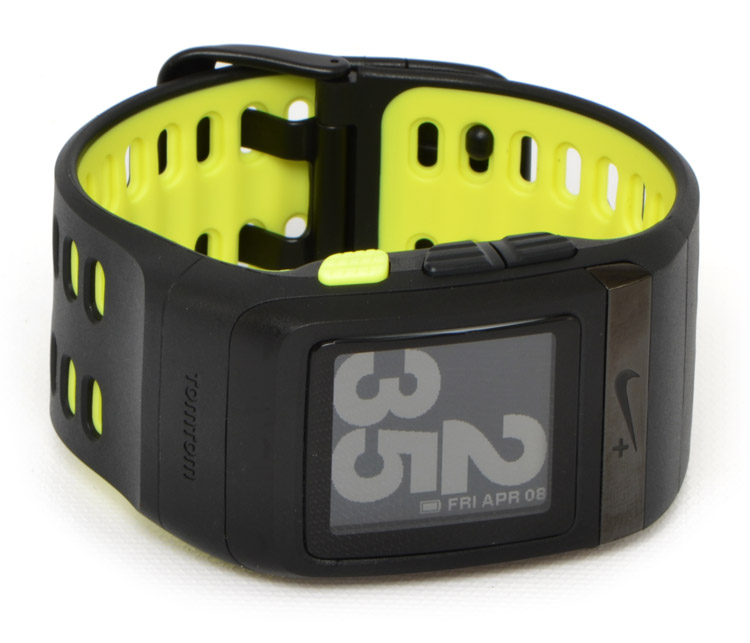
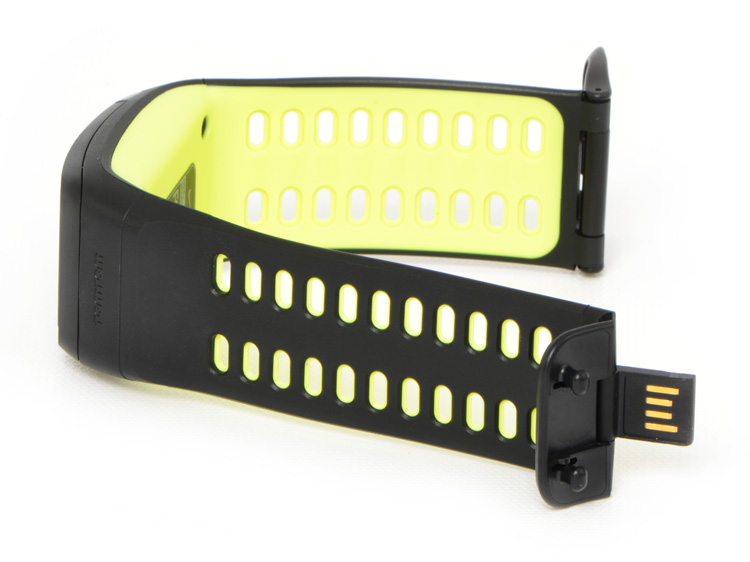
Though Nike makes some sharp conventional timepieces that look as good with khakis as they do with nylon running shorts, the SportWatch is not one of them. From the rigid rubber watchband and overly beefy face to the fluorescent “volt yellow” highlights, this is clearly an athletic watch through and through.
Nike+ SportWatch GPSIt works. An inch-wide band keeps it firmly grappled to your wrist, a sturdy dual-pronged clasp ensures it won’t unhook accidentally, and the closely-spaced perforations let your wrist breathe while allowing tiny adjustments for just the right fit. The “excess” end of the watchband even has two prongs that snap into the holes beneath to keep it from flapping around.
The display on the SportWatch uses the same inverted white-on-black color scheme that a lot of trendier sports watches use, which can be easier to read in the sun. It’s also surprisingly dense with pixels, so numbers and even tiny print look smooth and easy to read.

Features

The same running-centric design that dictates the SportWatch’s styling applies to the features Nike has crammed in: If it doesn’t have anything to do with running, the SportWatch won’t do it. Even the most basic features you could find on a kid’s digital watch, like an hourly chime or alarm, have been stripped out. There’s no question Nike could have included these features, but we suspect it was an intentional move to cut the clutter and avoid anything that could interfere with the running settings.
Nike+ SportWatch GPSPut it in “run” mode and things start to get interesting. Using an internal GPS sensor (“powered by TomTom”) or the Nike+ sensor you pop in a shoe, the SportWatch GPS will tell you your pace, total distance, total time elapsed and total calories burned, all at a glance, on the move. Though it saves every run in the watch, the real fun comes when you get home. The wristband actually conceals a full-size USB connector which you can pop open, plug into your PC, and push every detail of your run online to a Nike+ account. Your runs are chronicled by date, available for others to see, and meticulously plotted against Google Maps with your pace overlaid in full color.

Setup

Part of the beauty of owning a watch that plugs into a computer comes from actually setting it up on the computer, rather than spending twenty minutes reading a matchbook-sized manual and clicking buttons the size of pinheads to set the time. The first time you plug the SportWatch in, it prompts you to download Nike+ Connect software, a lean and unobtrusive app that interfaces with the watch. Really, you’ll only use it to configure the watch and upload data, the meat and potatoes reside online. Consequently, Connect requires you to create a Nike+ account the first time you use it, which serves as repository for everything you’ll add from then on. After that, it’s a simple matter of choosing your preferred distance units, entering your weight, gender and a few other specifics, and you’re off and running. Literally.

Sunday, April 10, 2011

Gaming tops tablet activity, says Google study

A new survey by Google AdMob has found that tablet owners primarily use their touchscreen devices for playing games, the Guardian reports. Other popular uses include emailing, social networking and consuming media like videos, music and e-books.
Out of the 1,430 tablet owners interviewed, 84 percent used the device for playing games. “Searching for information” came in as the second most-popular activity at 78 percent, followed by emailing (74 percent), reading the news (61 percent) and using social networks (56 percent). Only 51 percent use their tablets for watching videos or reading music, the study found. And Reading e-books was only popular among 46 percent of those interviewed.
The study (PDF) also shows that tablets, while not yet more popular than PCs, are certainly making headway against their bulky competition with 28 percent identifying their tablet as their primary computer, and 43 percent admitting that they spend more time using their tablet than their PC.
Despite obvious benefit of being able to easily take a tablet anywhere, most people (82 percent) say they mostly use their device at home. A mere 11 percent said they use their tablet as a mobile device. A total of 68 percent of owners use their tablet at least one hour per day, with 34 percent admitting that they use the device for two or more hours daily.
While some of the information wasn’t much of a surprise (59 percent use their tablets more than they read books), the study did find that 1 in 3 tablet owners use their tablet more than they watch TV. (Which would probably explain why Time Warner and Cable vision are so anxious to offer their programming on the iPad.)
Google never explicitly mentions what type of tablet those they interviewed own, but considering that the study was conducted last month, it’s safe to assume that a large percentage of those polled owned an Apple iPad.