When it comes to the racing genre you have two options. You can go with the racing simulators— the Forza and Gran Turismo series games— where you can lose hours of your life fiddling with gear differentials, weight distribution and thousands of other things that most of us will never truly understand. Most importantly though is a realistic sense of physics in the actual driving. On the flip side of the coin are the arcade style racers, which drop you in places like Burnout’s Paradise City, or Midnight Club’s Los Angeles and command you to go forth and race while trying not to hit a building at 200 mph. Both are racing games, but there is a massive gap between the two genres. Shift 2: Unleashed is a game that tries to fill this gap, and does a fairly decent job of it.
Shift 2: Unleashed is the heir to the Need for Speed series that has reinvented itself, and changed from the arcade style that had you running form cops through all environments, to a more simulated racer; but the vestigial traces of the original series remain, and in doing so they offer something that is a bit unique.
Shift 2 is a racing simulator in the sense that it is all track based and where the cars are unbelievably customizable; but the racing is what sets it apart. While there is a sense of realistic physics at work, the game has an arcade feel to it that bends those physics. You can hit a corner at high speed and drift around the bend, when in reality you would probably hit the wall and explode. It may not be absolutely realistic in that sense, but it works, and makes a racing game that combines the simulator and arcade style with an exceptional balance that makes it just plain fun to play.
An online mode is also available, and “lobbies” offer races of all classes and styles. You can race in ranked and unranked matches, as well as head-to-head in a “Driver Duel” against another person with a similar rank. In these races you race a best of three series, and the winner receives cash, experience and a crown. The more crowns you earn the better your rank.
One interesting feature that fans of the series will love is that if you have played the previous games in the Need for Speed series, your game will recognize that and award you with additional experience, cash, and a few other perks. It isn’t anything that you can’t unlock on your own so new fans aren’t missing anything, but it is a nice touch to reward fan loyalty. If you haven’t played the series before, and if you don’t have the patience to unlock your cars through progression, there is also the option to buy cars using Microsoft points. Some people might call this a cash grab, but it really is an interesting option for people. It adds to the game, and while most purists will sneer at it, it won’t affect their game in any way. Alternatively, it might make casual fans more into the game.
First is the limited number of cars. The selection of the cars is fairly robust, with 145 cars from 37 manufacturers. From a Ford Focus to a Bugati Veyron, the selections are fairly impressive. Shift 2 doesn’t have the sheer number of choices that some of the other games, like Gran Turismo 5’s 1000+ cars, but honestly will anyone miss a VW Jetta or a Kia Spectra when you can use a BMW or an Audi from the start? There are plenty of options.
While the car selection is solid albeit unimpressive, the customization options for the cars run so deep that you can use every car thousands of times and it would be slightly different each time. While the number of options is incredible, it can also be incredibly overwhelming. Unless you are a gearhead—and not just a “Hey, I watch Top Gear” gearhead, but a gearhead in the sense that you can read on the screen that you are adding a new gear box and you will instantly understand what that will do to the car without the benefit of pages of stats—then you might have some troubles.
The customization menu is huge, but it offers little to no help. Granted, in the real world when you customize a car, adding new suspension or tires makes a notable difference, but in a video game it is harder to tell. This makes it tough to know exactly what you are doing—unless you actually know exactly what you are doing. Most gamers have the tendency to just go for more of everything, which isn’t always the best option. It is about balance, a rule Gran Turismo taught us years ago, but Shifted 2 makes it oddly tough to find that balance. Average gamers—especially ones used to the more arcade like upgrades of the old Need for Speed series—are going to face a ton of trial and error, and most are likely to do only the most obvious changes to their rides.
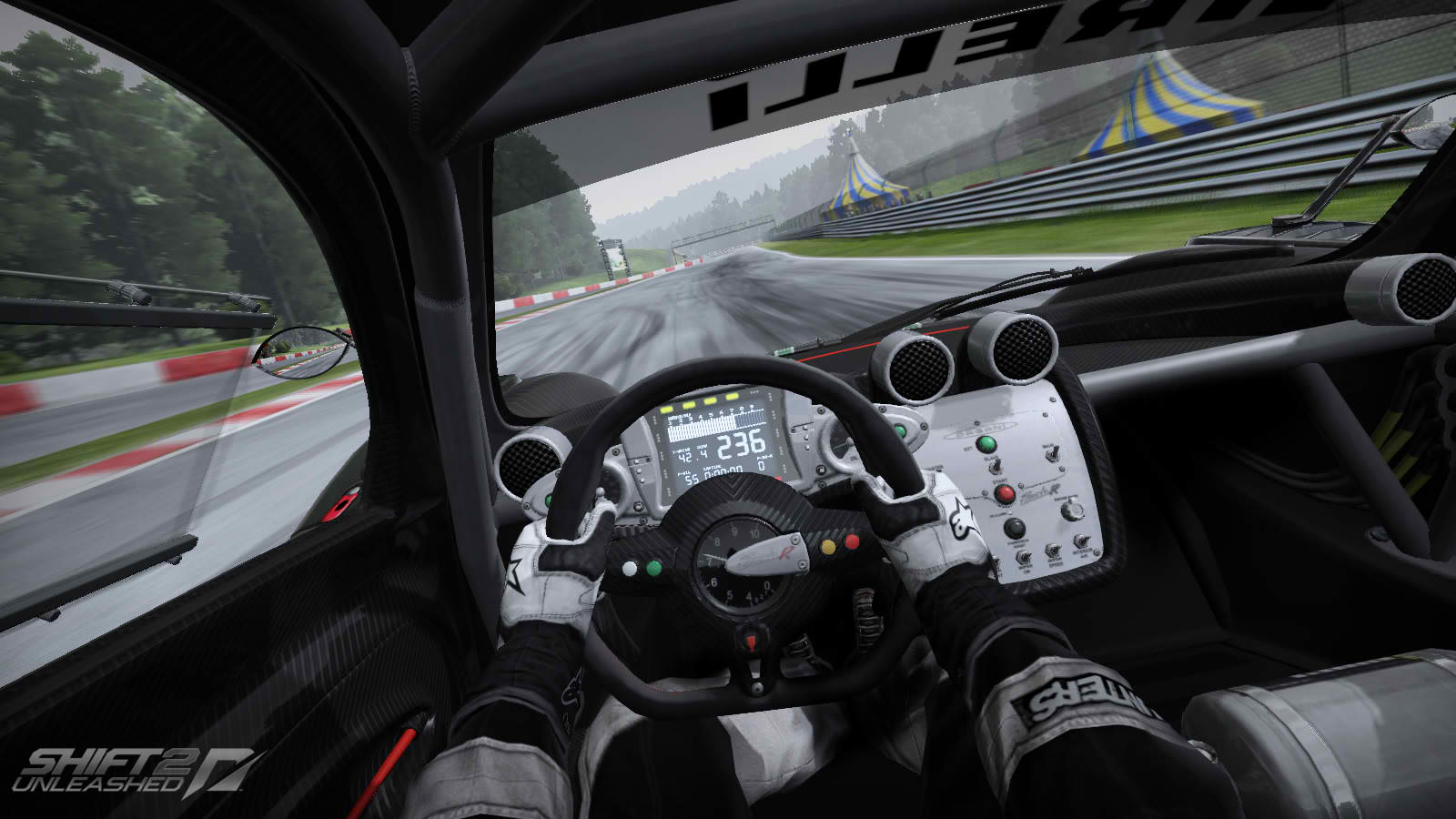
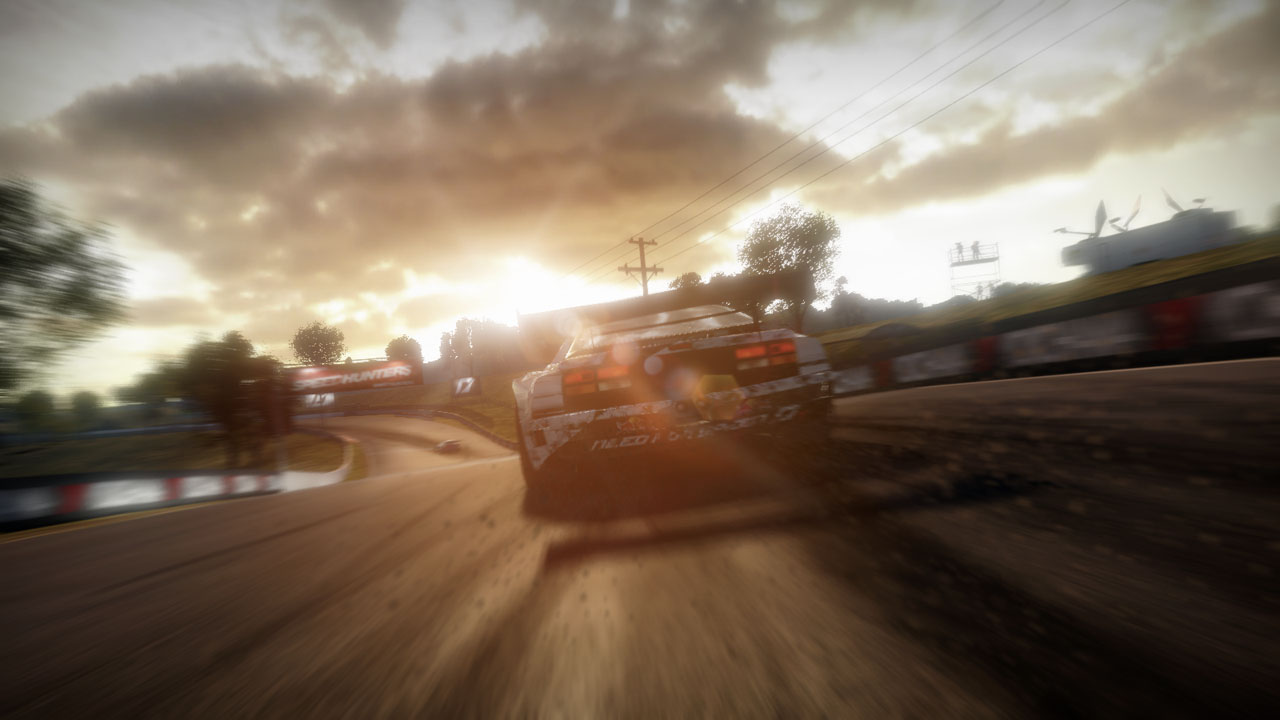
The graphics are also good, but not amazing, and that is something of a theme for this title. The lighting effects in particular are exceptional, and the interior view is well rendered, but some of the cars look cartoonish, and there is an inconsistency that stands out. There is also a series of videos to introduce segments, and they can quickly become annoying.
What Shift 2 has is well done, but it doesn’t offer anything surprising or impressive, with the possible exception of the gameplay (which granted, is a good thing to excel at). You get exactly what you would expect, and no more. There are no neat channels to watch racing videos on, nor are there go-kart challenges. You won’t find a personalized racing calendar, or off track events. You have tracks, you race them, you buy new cars—that’s it. Even the online—while fun—is somewhat barebones and there is a distinct sense that building a community was a low priority. That may all sound like nitpicking, but when you are trying to break into a field dominated by giants like Gran Turismo and Forza, you have to at least try to offer something that the other don’t. Everything in Shift 2 can be found in other games, and while the limits of the options won’t hurt the actual playability, which is great, it will likely stunt the game’s lifespan.
To encourage you to race properly, and to give the game a bit more value during the races, if you slam into a car, it will remember. More than that, it will swear a vendetta against you, and make it its primary purpose in life to utterly destroy you. A nudge here and there might get you an aggressive bump in return, but a reckless slide into the side of a rival will have them seeing red, and you will spend the rest of the race nervously watching your rear view mirror for an angry blur that wants your (digital) blood.
In this, the AI in Shift 2 is amazing. They are not an easy set of racers to crush, they are responsive and adaptive, and you need to bring you’re A-game to finish in first. One of the more clever ideas in the game is that when you first begin, you race a few challenges, and the results determine your level of difficulty and car settings. As you progress so does the difficulty, and it is a nice touch to have the game adapt to you.
But regardless of whether or not you are in the easy or hard difficulties, the races are not going to be handed to you—you need to beat your opponents. They will test you, and force you to drive almost perfect races—not perfect in the sense that you have to hit every corner perfectly, just in the sense that if you hit a wall–even if you don’t wreck–you may as well start over if you are determined to win. Sometimes this is logical. If you are in a tough race and mess up, you will naturally be overtaken. But other times you can have a big lead and not even see the next car in your rear view, then you take a turn too harshly and slow down off the track, and you will almost magically find yourself in last place.
The AI has moments where it is brilliant, but it also has moments where it is very, very bad. You might be in a dogfight with the top 2 cars, while the others are 5-10 seconds behind—then suddenly they will all have made up an improbable gap, regardless of how well you are driving, and you will be surrounded. It doesn’t usually make a difference to how you race, but it is noticeable.
Still, the pros of the AI outweigh the cons, and they make the races challenging and fun.
The AI is a bit unbalanced at times, but when it works it works brilliantly. The graphics aren’t the best, but they are better than many, and while the career mode is relatively short—at least compared to other games of the genre–it is varied enough to keep the races feeling fresh. The biggest issue though is that there isn’t anything new. What there is, is great, but there isn’t anything that will surprise you.
Still, faults and all, racing fans won’t regret giving this game a try, and the arcade pedigree should offer a bit of appeal to gamers everywhere. It may not have the depth to satisfy hardcore fans for too long, but Shift 2 has the gameplay to have them smiling while they try.
Shift 2: Unleashed is the heir to the Need for Speed series that has reinvented itself, and changed from the arcade style that had you running form cops through all environments, to a more simulated racer; but the vestigial traces of the original series remain, and in doing so they offer something that is a bit unique.
Shift 2 is a racing simulator in the sense that it is all track based and where the cars are unbelievably customizable; but the racing is what sets it apart. While there is a sense of realistic physics at work, the game has an arcade feel to it that bends those physics. You can hit a corner at high speed and drift around the bend, when in reality you would probably hit the wall and explode. It may not be absolutely realistic in that sense, but it works, and makes a racing game that combines the simulator and arcade style with an exceptional balance that makes it just plain fun to play.
The Garage is Small, but Well Stocked
Shift 2 features exactly what you might expect a racing sim to offer. You have a career mode which unlocks features as you earn experience with cash to buy new cars. Also, as you progress, you earn the right to race with different classes of cars-like muscle cars and eventually F1 supercars. As you progress through the 36 different maps, you can also tune your car via an incredible amount of options.An online mode is also available, and “lobbies” offer races of all classes and styles. You can race in ranked and unranked matches, as well as head-to-head in a “Driver Duel” against another person with a similar rank. In these races you race a best of three series, and the winner receives cash, experience and a crown. The more crowns you earn the better your rank.
One interesting feature that fans of the series will love is that if you have played the previous games in the Need for Speed series, your game will recognize that and award you with additional experience, cash, and a few other perks. It isn’t anything that you can’t unlock on your own so new fans aren’t missing anything, but it is a nice touch to reward fan loyalty. If you haven’t played the series before, and if you don’t have the patience to unlock your cars through progression, there is also the option to buy cars using Microsoft points. Some people might call this a cash grab, but it really is an interesting option for people. It adds to the game, and while most purists will sneer at it, it won’t affect their game in any way. Alternatively, it might make casual fans more into the game.
The Drip Beneath the Car
While Shift 2 does play very well, there are a few things that prevent it from stealing the crown from the Forza or Gran Turismo series. There is nothing that makes this game anything less than awesome, but there are a few things that hold the series back.First is the limited number of cars. The selection of the cars is fairly robust, with 145 cars from 37 manufacturers. From a Ford Focus to a Bugati Veyron, the selections are fairly impressive. Shift 2 doesn’t have the sheer number of choices that some of the other games, like Gran Turismo 5’s 1000+ cars, but honestly will anyone miss a VW Jetta or a Kia Spectra when you can use a BMW or an Audi from the start? There are plenty of options.
While the car selection is solid albeit unimpressive, the customization options for the cars run so deep that you can use every car thousands of times and it would be slightly different each time. While the number of options is incredible, it can also be incredibly overwhelming. Unless you are a gearhead—and not just a “Hey, I watch Top Gear” gearhead, but a gearhead in the sense that you can read on the screen that you are adding a new gear box and you will instantly understand what that will do to the car without the benefit of pages of stats—then you might have some troubles.
The customization menu is huge, but it offers little to no help. Granted, in the real world when you customize a car, adding new suspension or tires makes a notable difference, but in a video game it is harder to tell. This makes it tough to know exactly what you are doing—unless you actually know exactly what you are doing. Most gamers have the tendency to just go for more of everything, which isn’t always the best option. It is about balance, a rule Gran Turismo taught us years ago, but Shifted 2 makes it oddly tough to find that balance. Average gamers—especially ones used to the more arcade like upgrades of the old Need for Speed series—are going to face a ton of trial and error, and most are likely to do only the most obvious changes to their rides.
The graphics are also good, but not amazing, and that is something of a theme for this title. The lighting effects in particular are exceptional, and the interior view is well rendered, but some of the cars look cartoonish, and there is an inconsistency that stands out. There is also a series of videos to introduce segments, and they can quickly become annoying.
What Shift 2 has is well done, but it doesn’t offer anything surprising or impressive, with the possible exception of the gameplay (which granted, is a good thing to excel at). You get exactly what you would expect, and no more. There are no neat channels to watch racing videos on, nor are there go-kart challenges. You won’t find a personalized racing calendar, or off track events. You have tracks, you race them, you buy new cars—that’s it. Even the online—while fun—is somewhat barebones and there is a distinct sense that building a community was a low priority. That may all sound like nitpicking, but when you are trying to break into a field dominated by giants like Gran Turismo and Forza, you have to at least try to offer something that the other don’t. Everything in Shift 2 can be found in other games, and while the limits of the options won’t hurt the actual playability, which is great, it will likely stunt the game’s lifespan.
The AI Hates “Days of Thunder”
Most of us were raised with the idea that “rubbin’ is racin’”. While this quote comes from the film Days of Thunder, the idea comes from the more primal idea that if a car is in your way, and there are no consequences to annihilating him, then it is fine to introduce him to a wall at high speeds. Shift 2 disagrees.To encourage you to race properly, and to give the game a bit more value during the races, if you slam into a car, it will remember. More than that, it will swear a vendetta against you, and make it its primary purpose in life to utterly destroy you. A nudge here and there might get you an aggressive bump in return, but a reckless slide into the side of a rival will have them seeing red, and you will spend the rest of the race nervously watching your rear view mirror for an angry blur that wants your (digital) blood.
In this, the AI in Shift 2 is amazing. They are not an easy set of racers to crush, they are responsive and adaptive, and you need to bring you’re A-game to finish in first. One of the more clever ideas in the game is that when you first begin, you race a few challenges, and the results determine your level of difficulty and car settings. As you progress so does the difficulty, and it is a nice touch to have the game adapt to you.
But regardless of whether or not you are in the easy or hard difficulties, the races are not going to be handed to you—you need to beat your opponents. They will test you, and force you to drive almost perfect races—not perfect in the sense that you have to hit every corner perfectly, just in the sense that if you hit a wall–even if you don’t wreck–you may as well start over if you are determined to win. Sometimes this is logical. If you are in a tough race and mess up, you will naturally be overtaken. But other times you can have a big lead and not even see the next car in your rear view, then you take a turn too harshly and slow down off the track, and you will almost magically find yourself in last place.
The AI has moments where it is brilliant, but it also has moments where it is very, very bad. You might be in a dogfight with the top 2 cars, while the others are 5-10 seconds behind—then suddenly they will all have made up an improbable gap, regardless of how well you are driving, and you will be surrounded. It doesn’t usually make a difference to how you race, but it is noticeable.
Still, the pros of the AI outweigh the cons, and they make the races challenging and fun.
Conclusion
Shift 2 does exactly what it sets out to do. Developer Slightly Mad Studios has created a racing game that takes the customization options of a true racing sim, and combines it with a touch of arcade style racing to give us something that falls between the two. The results are a game that is just plain fun.The AI is a bit unbalanced at times, but when it works it works brilliantly. The graphics aren’t the best, but they are better than many, and while the career mode is relatively short—at least compared to other games of the genre–it is varied enough to keep the races feeling fresh. The biggest issue though is that there isn’t anything new. What there is, is great, but there isn’t anything that will surprise you.
Still, faults and all, racing fans won’t regret giving this game a try, and the arcade pedigree should offer a bit of appeal to gamers everywhere. It may not have the depth to satisfy hardcore fans for too long, but Shift 2 has the gameplay to have them smiling while they try.